Runner Nutrition – My Observations
One of the cool things about coaching at the Olympic level is that you get to work with athletes from around the world.
You get to know different cultures, customs and environments. And, you get to observe the nutritional habits of successful runners and you quickly learn that there is not a special food or diet or supplement that is consistent across pro runners.
Instead, my observation is that successful runners follow a few key tenets of nutrition, yet the diet fits their culture, taste preferences and food availability.
For example, a Japanese runner includes fish as a key protein source and rice as a key carbohydrate source because Japan is an island nation. Kenyans, on the other hand, include grazing animals as their protein source and corn as a key carbohydrate source. Same idea but just different foods because of the different environments.
With this broad perspective, it’s clear you don’t need to get stuck on specific foods but rather should apply two key tenets of proper nutrition.
First, use your hands.
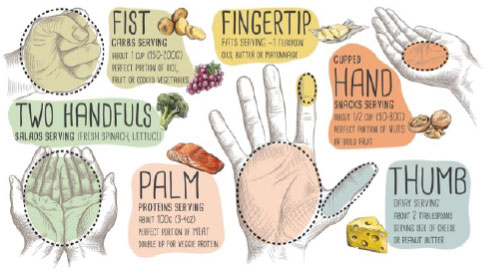
This image, for me, is the best tool to guide your food choices and portion sizes.
Two handfuls for your vegetables, your fist for your carbohydrates and the palm of your hand for your protein. Start there and you’ll control your portion sizes and begin to learn what fuels you best.
You may decide you function between with more or less of any one component but this concept is a great starting point (especially for young runners).
Second, eat the rainbow.
A lesson I learned from top sports dietician Amanda Carlson-Phillips is to “eat the rainbow.” If you look at most high-quality diet foods, they are a myriad of colors. When you include more vegetables and fruits as well as high-quality protein sources like salmon, your plate starts to look beautiful. It has lots of colors that look like what you’d find in nature.
Beyond being pretty, different colored foods (natural colors mind you, not artificial colors) also provide unique properties. You may have heard that eating carrots can help improve your vision. That’s because carrots have beta-carotene, which turns them orange and is what the body uses to make Vitamin A—and Vitamin A plays a role in improving your vision. Another example is green leafy vegetables: They are great sources of iron, which runners need to carry oxygen to working muscles. And how about pineapple? It contains bromelain, which helps repair your muscles after a hard run.
So, eat the rainbow. This goes hand in hand with a high-quality diet and portion control, because you can only fit so much on your plate, so the more colors you have, the more manageable those portions become. Plus, it’s hard to overeat a high-quality diet—natural, unprocessed, and varied foods satiate your hunger and fill your stomach, both of which keep you from overeating.
Contrast this with processed foods, which are designed to make you always want more. That’s right, food scientists have concocted junk foods that actually make you crave more, ignore your body’s normal fullness signals, and consume more and more of the low-quality foods. As a result, it’s even more important to eat as many natural, unprocessed, “straight-from-the-earth” foods as you can so that there really isn’t room in your diet for these addictive junk foods.

SPECIAL OFFER
For a limited time, I’m offering a 14-day free trial of McMillan Training. Take a plan for a spin. Kick the tires as they say. If you like it, do nothing and your subscription will start. If you don’t like it, just cancel and you owe nothing. It’s a great way to experience training on what has been called, “The best training system on the planet.”