

Running performance is a combination of your basic fitness (qualities that come from endurance and stamina) and your speed fitness (qualities that come from your speed and sprinting ability). When you were born, you had both basic fitness and speed fitness as represented by what I call your Pyramid of Performance (taller pyramid equals faster racing) shown below.
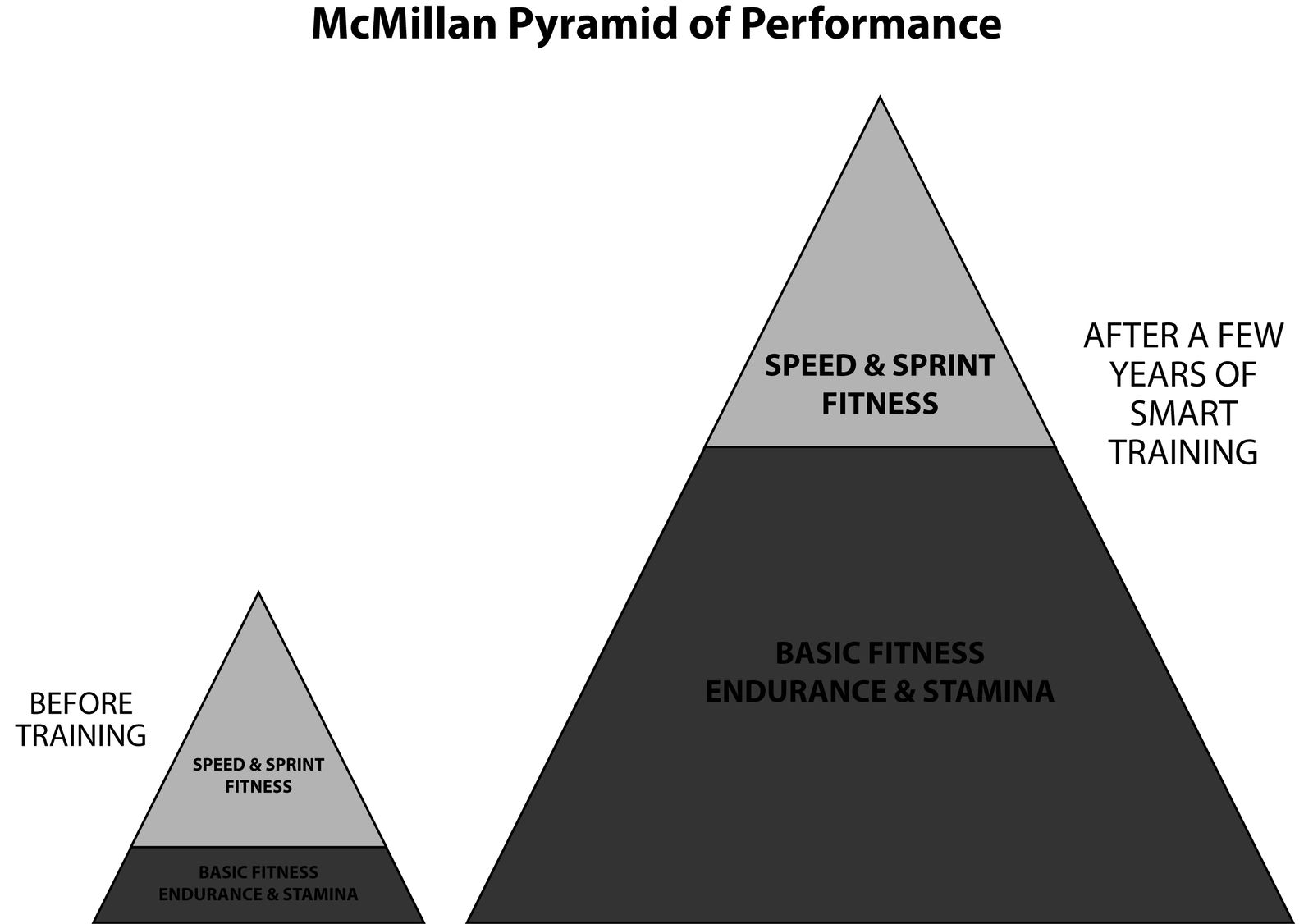
While this may be a relatively simple view of all that goes into your performance, it illustrates the point that when you begin training, your performance is not as great as it will be after a few years of training. More importantly, however, is that the greatest improvement in your performance over the course of your running career comes from improvements in your basic fitness. (Notice how large the base of the pyramid gets after a few years of running.)
Runners can certainly improve their speed and sprinting ability (the top of the pyramid gets bigger with training) but this can only improve a relatively small amount. But, look at the base. Over a few years, you can markedly improve your endurance and stamina thus providing a larger base and pushing your total performance much, much higher.
Here’s a great example of how important the endurance and stamina components are. Brett Gotcher, one of the world-class runners I coach, ran 4:33 for the mile as a freshman in high school. His coach, Dan Gruber, did an excellent job of building Brett’s basic fitness so that by the time Brett was a senior, he could double his freshman mile time, running 8:55 for two miles. Then, while at Stanford University, Brett continued to build his endurance and stamina so that by graduation he could now run his freshman mile pace three times in a row (14:04 for 5,000m).
Since joining my group of Olympic hopefuls, we’ve continued Brett’s development. It’s remarkable that he can now run his 5K (3.1 mile) race pace from high school for the full 26.2 miles in the marathon! It really is amazing how much the basic fitness can improve over time and Brett’s progression is testament that the pyramid of performance will continually rise if you add a hefty dose of endurance and stamina training across your running career.
The bottom line is that you need both aspects of fitness to run your best. But, while speed and sprint workouts are fun to do and you get a quick fitness boost, smart runners and coaches know that it is your basic fitness (endurance and stamina) that is the most important over the long term. Build your base larger and higher and then you can stack your speed fitness on top of it, leading to faster race performances.

Written By Greg McMillan
Called “one of the best and smartest distance running coaches in America” by Runner’s World’s Amby Burfoot, Greg McMillan is renowned for his ability to combine the science of endurance performance with the art of real-world coaching. While getting his graduate degree in Exercise Science he created the ever-popular McMillan Running Calculator – called “The Best Running Calculator” by Outside Magazine. A National Champion runner himself, Greg coaches runners from beginners to Boston Qualifiers (15,000+ and counting!) to Olympians.
NEWEST ARTICLES: