
I’m going to start by stating categorically that there is no one best running form. Runners come in so many different shapes, sizes and proportions that it’s simply illogical that one running form, like one training plan, would work for all runners.
That said, there are a few keys to improving your form, which should help you stay injury-free, perform better and at the least, look better in those race photos!
1) Posture
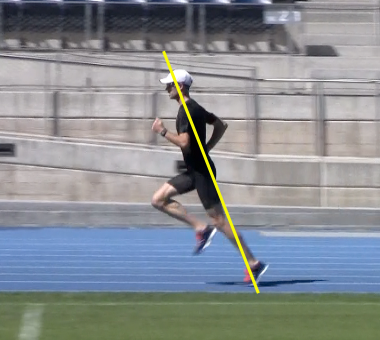
The same posture that’s good in your everyday life is good for your running. Remember when your mother frequently told you to sit up straight? Well, if I’m working with you on our form, you’ll hear me telling you to “run tall.” This cue, run tall, helps get you in an upright, non-slouching posture, which is best for running. As McMillan Coach and resident Olympian Andrew “Lemon” Lemoncello shows in the photo below, head above shoulders, shoulders above hips, hips above knees and ankles. Modern life encourages us to slouch so fight that in running and run tall. Your mom would be proud. Extra note: If you feel slow in your running, think “run tall and lean forward.” You’ll run faster. By running tall, you’ll naturally lean at the ankles and then can run faster without over-striding.
2) Arm swing
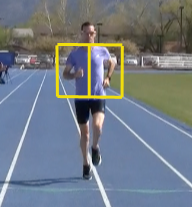
When running, your arms should be bent at roughly 90 degrees (slightly more or less is also okay). Your hands should be lightly clasped and when your arm swings, your hands should brush between your lowest rib and your waistband. The swinging action itself is front to back and relaxed. Any abnormal swinging (crossing the body, elbows wide, shoulders high) will have consequences in your mechanics. Race photos often illuminate any arm swing issues and you can have someone video you while running from the front and back to evaluate your arm action. Again, as Lemon demonstrates, imagine there is a box or picture frame from your shoulders to your hips. Your arm swing should be within this box and your hands should not cross the midline of the body. Don’t be rigid but just make sure your arms stay within the box.
3) Foot plant
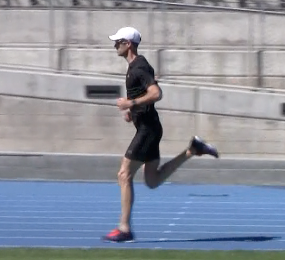
There is a lot of chatter about foot plant. In my opinion, it matters less whether you land toward the front of the foot or the rear. What matters most is that you land under your body (or at least close to under the body). Overstriding is more of an issue than where you land on your foot. Runners can overstride with a forefoot plant as well as a heel plant. The key is to focus on landing under you and pushing behind you. (In the photo below, note that Lemon isn’t reaching out but is landing under his body.) I find if runners think not about reaching out in front to go faster but instead think about pushing harder down and behind, they cure their overstriding. Again, have someone video you from the side while you are running and you’ll see if you are landing far in front of your body (overstriding) or nearly under your body (correct landing).
4) Cadence
A few years ago, researchers suggested a cadence (or stride frequency) of 180 steps per minute was optimal. I would suggest anything from 170-190 works depending on the runner. If you look at most runners, regardless of speed, that look really good, they usually have around this cadence.
You can count your steps in one minute to get your cadence or most GPS monitors now do this for you as well. If you do find you need to increase your cadence, just make sure you aren’t sacrificing stride length by shortening your stride too much. Understriding to achieve an optimal cadence will slow you down. We want an optimal stride rate (cadence) and an optimal stride length. They both go together to create our speed.
5) Rhythm
Running is like dancing and the runners who look the best, again regardless of speed, are the ones that have great rhythm when they run. There is a certain flow to their stride. They are relaxed and rhythmic. Think of this when you run. We like to say, “Run tall. Run relaxed.” This simple cue usually cures most form issues and results in a great running rhythm.
Click to watch a video of Lemon running. Visualize this on your next few runs to help you improve your form.
In closing, I like that we all have our unique running forms. I like that I can spot my training partners from a mile away just by their stride. Few runners need a complete overhaul in their stride. Stick with your signature stride but just make sure you adhere to these 5 keys to good form since bad habits can easily creep into our running form.
Learn more about our Form Drills for Distance Runners follow-along routine to improve your form and even prepare you for workouts and races.

Written By Greg McMillan
Called “one of the best and smartest distance running coaches in America” by Runner’s World’s Amby Burfoot, Greg McMillan is renowned for his ability to combine the science of endurance performance with the art of real-world coaching. While getting his graduate degree in Exercise Science he created the ever-popular McMillan Running Calculator – called “The Best Running Calculator” by Outside Magazine. A National Champion runner himself, Greg coaches runners from beginners to Boston Qualifiers (15,000+ and counting!) to Olympians.
NEWEST ARTICLES: